
 |
| Add caption |
Monday, September 17, 2012
Romney Explain Obama's Voters
I cannot respect a man who feels so dismissive of half of the American electorate.


Sunday, September 16, 2012
 Mentor: The Kid & the CEO: A Simple Story of Overcoming Challenges and Achieving Significance by Tom Alan Pace
My rating: 3 of 5 stars
On the back of the book there is the claim, "Tony's [the book's narrator and protagonist] story will change your life." I have always been skeptical of such claims, particularly when made of a "self-help" book. And this one didn't (so far) change my life. However, I am probably not the book's primary target audience.
Mentor, written by Tom Pace with Walter Jenkins, told from the point of view of a young man named Tony, age 19, who is sent to jail for a parole violation and faces the real possibility of going to prison for several years. While in jail awaiting sentencing, he goes to a group therapy session run by a businessman named Malcolm who offers all who come the hope of turning their lives around. At first, Tony is skeptical and barely listens to Malcolm, just glad to escape the boredom of jail life. However, in a fairly short amount of time, largely due to the encouragement of a "lifer" convicted of murder, Tony attends, listens and becomes interested.
Malcolm stays to talk to Tony and gives him the book "The Greatest Miracle in the World" by Og Mandino to read. Tony doesn't read the book at first, but finally, with Malcolm's encouragement reads the book and begins a life-changing journey. Malcolm acts as Tony's mentor, and when Tony is released from jail without having to go to prison (due to his good behavior), Malcolm is there for him to offer guidance and encouragement. As is typical for these stories, Tony, by following Malcolm's sage advice, and through his own hard work and perseverance, succeeds as a person, a businessman, and a family man. (Tony goes to church and there meets the love of his life.)
All through the book, in the bottom margins, are bits of wisdom and advice like "finish what you start," have integrity," "have values," "save 10 percent," "read books," and so on.
I respond to this book on different levels, wearing different hats.
My book critic hat, for example, says that this is a pretty average plot line. The conflicts are resolved rather quickly with little dilemma. Malcolm introduces Tony to Gary, also a ex-con who now owns a backhoe business. It just so happens that Gary has a need for some extra help. Surprisingly, it takes a chapter or two for Gary to realize that Malcolm is the answer to his problem. Malcolm later gets into financial trouble and faces a class action lawsuit. He solves this problem by selling some of his property, and the suit is dismissed as "frivolous." Great plots are not this neat. The Joads have no property to sell to get them out of their troubles. They mortgaged it away long before they are dispossessed.
However, when I look at the advice the book offers, I am pleased with it. The advice is simple, mainly involving taking responsibility for yourself and working hard to achieve your dreams. Simple is often good and the advice is good in this simple form. My students, many of whom have already made some wrong choices (I have several fathers and mothers in my English 11 class.), should heed the advice in the book. The book is easy to read and moves quickly. Mr. Pace has made several copies of the book available to my school and others in our district. I plan to use them.
The next hat I put on is my teacher hat. I can use this book to further some lessons I have been teaching this year, particularly those involving the Heroic Archetype. Tony is on a journey, a quest for significance. He follows many aspects of the archetype, particularly, as the title says, having a mentor. He also descends into the "belly of the beast", both the jail and his own limited thinking, rises out of the depths to fight his enemies, those of his inner character. He emerges victorious and brings something good from his life: a business, a family, an opportunity to mentor others.
However, the last hat I wear is my social hat. Pace's philosophy is one of individual initiative and personal responsibility. It is a philosophy rooted deep in the American psyche and includes adherents as American as Ben Franklin, Ralph Waldo Emerson, and Dale Carnegie. (Tony reads "How to Win Friends and Influence People.") It's the American ideal of "rugged individualism." I have no quarrel with those who remind us that we are ultimately the ones responsible for our lives. However, we are not in this alone. We cannot ignore larger social forces at work that create the Tonys of our country. Poverty is not just an individual problem. Pace only hints at the larger social forces at work in America. Tony at first cannot find a job because businesses won't hire felons. He is lucky to be living with Gary when Gary, a convicted felon and therefore sympathetic to Tony's plight, develops the need for another employee. Pace also never mentions Tony's race, probably for good reason, but we cannot ignore the fact that race and poverty have become in inexorably intertwined in America.
Yes, we need individual action; my students need to take action to move their lives in a positive direction. We need self-help books, but we need just as much "social-help books" and social mentors. We do have them in America,books like "Nickel and Dimed: On (Not) Getting By in America" by Barbara Ehrenreich and mentors like Marian Wright Edelman of the Children's Defense Fund.
Too many individual responsibility advocates look at these voices and claim that these community organizers somehow shirk our need for individual responsibility. Such is not the case. Instead, they make us aware of the systems we have in place in this country that have led to the largest gap between rich and poor in our nation's history, and they make us ask, "why?" Are the millions of poor people in this country simply lazy? Is there not something wrong about a person working full time at minimum wage and still being far below the poverty line?
Of course, that is not the focus of Pace's book. Where he is focused, he does well. My students would do well, or at least much better, if they followed his advice. For that reason, this book, will be good for them. As I said, I plan to use it.
View all my reviews
Saturday, September 08, 2012
Steampunk Mini-Con Downtown Library
I attended a "Steampunk Mini-Con" at the Oklahoma City Downtown Library today.
I meet many interesting people; several of whom are pictured here. I also heard a presentation on games from the Victorian era and even got to make a "steampunk toy", which I unfortunately left behind (sob).
Here are some of the folks who came in costume:
I meet many interesting people; several of whom are pictured here. I also heard a presentation on games from the Victorian era and even got to make a "steampunk toy", which I unfortunately left behind (sob).
Here are some of the folks who came in costume:
.JPG) |
| Kit Holley and Mandy Cole with daughter |
.JPG) |
| Caterra King, Shadowleaf Joyce, and Nikki Watson |
.JPG) |
| Anna and Ryan McKinley Ryan has authored two Steampunk books: The Pirate Bride and The Lost Crew |
.JPG) |
| Heather Copple, Samantha Royka, and Matt Copple |
.JPG) |
| Zenon Awful (that's the name he gave me) |
.JPG) |
| Xander |
.JPG) |
| Olivia, Andrew, and Nicholas |
Cat and I had a great time. I learned a good deal made some good contacts. I hope that some of these become good friends.
I am looking forward to Octopodicon, a much bigger Steampunk convention, or "Con" that will happen October 5-7 at the Magnuson Hotel in Oklahoma City. For more information, you can go to http://octopodicon.org
Tuesday, July 17, 2012
Barry Tramel's Reply to my comments on Penn State U Football
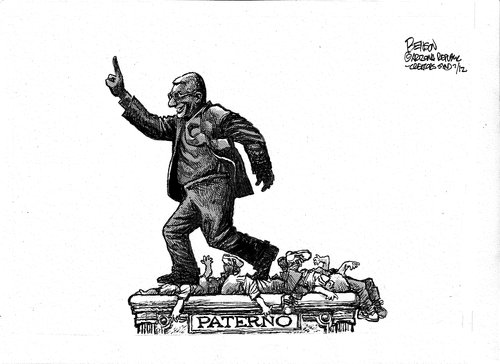
Lynn: Interesting. I guess I would say this. If Penn State football should be shut down, then the Catholic Church should have been shut down, too.What needed to happen was the Catholics (sic) to shut down themselves. What needs to happen if (sic) for Penn State to shut itself down. If the NCAA shuts down Penn State, it could have the reverse effect of changing the culture. It could galvanize Penn State into some kind of victim's mentality, that everyone is out to get them. That doesn't need to happen. The culture needs changed (sic).
(Please note that I have added the "sic" comments not in any negative fashion, but simply to quote accurately.)
My response was that the Catholic Church has to answer to its authority for its actions (a slightly higher one than the NCAA). However, PSU has to answer to the NCAA for its actions in sports, and that makes it ultimately the NCAA responsibility to see that PSU does the right thing.
Sunday, July 15, 2012
Should Penn State Lose Its Football Program?

Hi Barry,
I would like to know your opinion about whether Penn State should lose its football program
I have read several opinion pieces calling for something like this to happen. I have to realize that my politics are quite "left-wing"; therefore, most of the blogs I read are of the same stripe.
However, I believe that Penn State has lost the right to run a football program, and that it should be closed for a significant amount of time. (5 years is the number I would call for.)
I have several reasons for this:
1. This was not just a horrible crime. It was also a systemic failure of a program more concerned with image and self-preservation than with the innocent lives being destroyed.
2. Since those in charge of the football program were covering up these crimes to protect the program, the penalty for their crimes should be the loss of what they attempted to protect.
3. This would send a message to all of college football that it is far better to "tarnish your image" than it is to engage in a cover-up since you risk losing anything to tarnish.
I am aware of at least some of the arguments against ending PSU football, and in my, perhaps not so, humble opinion, they don't hold water.
1. This would punish innocent football players. Yes, these young men would have to find a new program as their step ladder to the NFL or a college degree (perhaps), but if one is good enough to get a PSU scholarship, the odds are well in that player's favor to find a new scholarship.
2. This would "punish" "innocent" fans. First, I am sickened by many of the fans reaction to the scandal as they wanted to punish the victims for exposing the crimes. Also, there is no "right" to sports entertainment. The fans and alums of PS have no right to demand that their desire to paint themselves in school colors and show up on a fall Saturday precedes the need to provide a just punishment for a program that was involved in a criminal conspiracy.
3. The NCAA has no business getting involved in this. I know you argued this in a column you wrote, but I argue that PSU is not likely to take this step on their own. They should, but in the event they don't, the NCAA should do the right thing and do it for them. See my reason #3 above for my thinking on this.
I am guessing that you have a different perspective on this, and I would like your point of view. Should you wish, again, to include my remarks in your blog or elsewhere, you have my grateful permission.
Your loyal reader,
Monday, June 11, 2012
What I did on my first real day of vacation.
There are calendar dates like July 4th or December 25th, there are seasonal dates like the equinox and solstice, and then there are psychological dates where we feel that something has begun or ended.
Today, for me, was the first day of teacher summer vacation. We were officially through with school on June 2nd. However, that was a Saturday. Saturday we are always out of school whatever the time of year. The same goes for Sunday. Monday was "sortof" vacation but it was tempered with the fact that the next day, Tuesday, we were back at school for a 3 day teachers' workshop. Friday was recovery from Tuesday through Thursday, and then it was back to Saturday and Sunday.
Monday was the first day that was completely our own, our true beginning to summer vacation where we could do whatever we wished (within the bounds of legality) for however long we wished.
So I read books, that glorious pastime that all true English teachers lust after but never get to fully indulge. I read history books, Young Adult books, political books. I am in my version of heaven.
 Hope you are getting to enjoy your summer too.
Today, for me, was the first day of teacher summer vacation. We were officially through with school on June 2nd. However, that was a Saturday. Saturday we are always out of school whatever the time of year. The same goes for Sunday. Monday was "sortof" vacation but it was tempered with the fact that the next day, Tuesday, we were back at school for a 3 day teachers' workshop. Friday was recovery from Tuesday through Thursday, and then it was back to Saturday and Sunday.
Monday was the first day that was completely our own, our true beginning to summer vacation where we could do whatever we wished (within the bounds of legality) for however long we wished.
So I read books, that glorious pastime that all true English teachers lust after but never get to fully indulge. I read history books, Young Adult books, political books. I am in my version of heaven.

Sunday, June 10, 2012
Percy Jackson & The Olympians, Book Three: The Titan's Curse
 The Titan's Curse by Rick Riordan
My rating: 4 of 5 stars
This is the 3rd in the Percy Jackson and The Olympians series. In this, Percy searches for his friend Anabeth with the help of Artemis' huntresses who are searching for the goddess of the hunt. Percy's quest sembles the labor of Heracles: fighting the Nemean Lion, dealing with the Erymanthian boar,and finally, because the Titan they are fighting is Atlas, he holds the sky on his sholders.
Percy wins because he rejects the idea of being Heracles showing that he is growing as a man as he completes each quest.
View all my reviews
Saturday, June 09, 2012
Attended the Smith-Stuart Reunion in Edmond, OK
I attended a reunion made up of relatives from Cat's side of the family. These were from her mother's family, the Smith's and Stuarts. Enjoyed myself a lot.
 |
| The reunion was at the Bickham-Rudkin Park in Edmond, a very lovely place |
 |
| We bid on some gifts that were brought to help finance more reunions |
 |
| Some of Cat's relatives |
 |
| Some of the prizes for the bidding |
 |
| And, of course, I managed to get in a game of chess or two. |
Thursday, June 07, 2012
A Day of Good News and Bad News
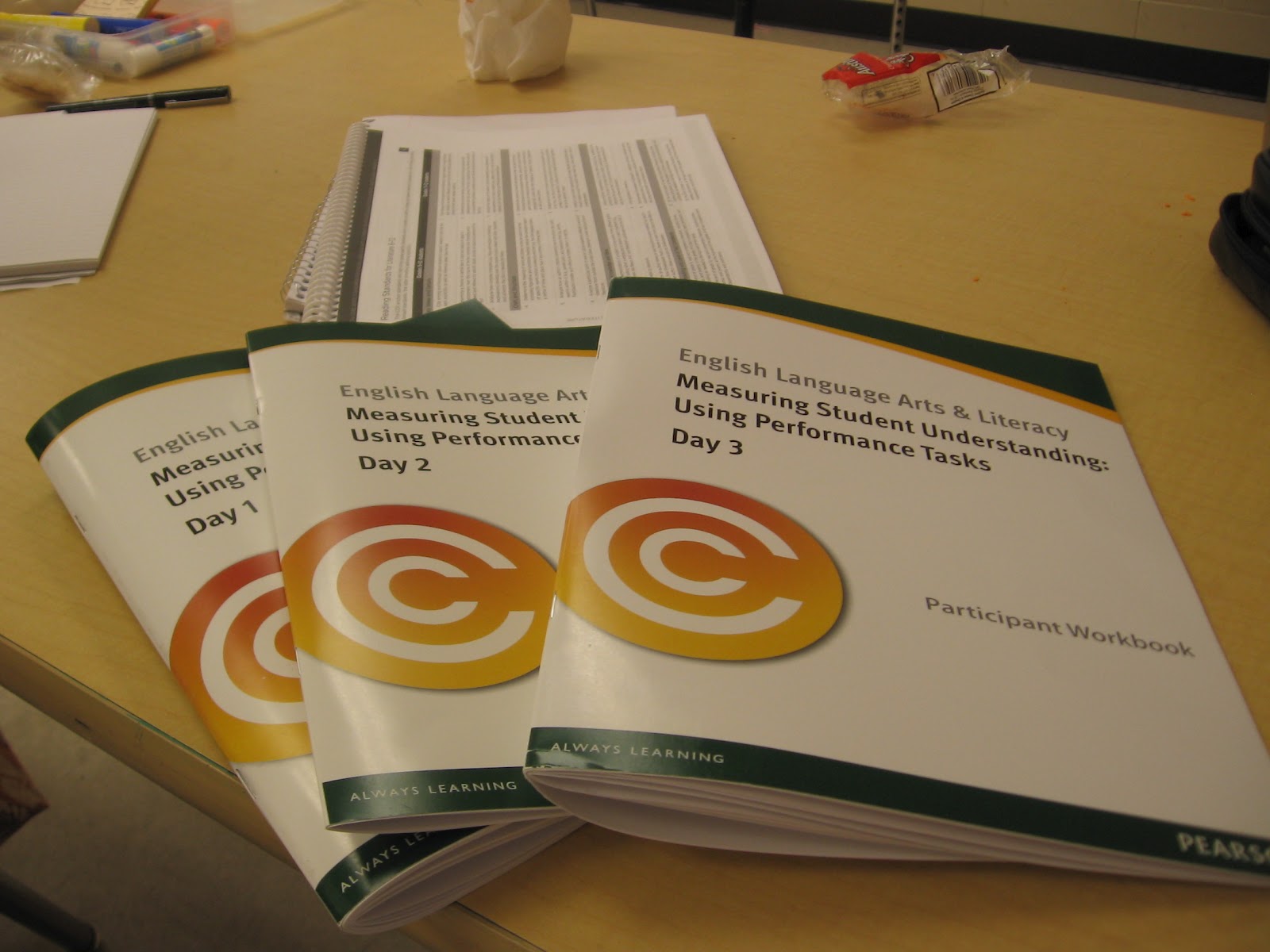
Today Cat and I got good news and bad news.
The good news is that the Performance Task training we finished today was some of the best professional development training either of us have ever experienced. A good deal of the credit goes to our excellent trainer Suzy Page, a very down to earth type of person who has real world teaching experience, in urban schools in Memphis, Tennessee no less!
 |
| Suzy helps a participant develop a performance assessment |
For example, one writing standard calls for the student to produce a narrative that demonstrates they understand how characters react to a given situation. One of the reading standards requires them to do character analysis. My performance task incorporates these objectives.
 |
| Native American Coyote figure |
My performance task calls for the students to read and analyze the character known as the "trickster" who appears in the myths and tales of all cultures. The trickster is an animal or a person who survives by his wits as opposed to his strength. Think Bugs Bunny or Huck Finn. In my performance task, the character they will analyze is Coyote, a common trickster figure in many Native American cultures. My students' performance task is to create their own trickster character and have their trickster solve a problem using the skills that the figure possesses. I hope to use their writings in an anthology of student work we will create during the year.
Now for the bad news.
Cat and I had hoped to visit my folks in Washington state this summer. On Tuesday I took our PT Cruiser into Hibdon's Tire for an oil change and a diagnostic once over. The car is still at Hibdon's and the bill currently stands at over $2000! It seems that the car needed new struts, had oil in the brake line, and needed a new master cylinder. So, we will be staying home this summer with maybe a few short trips here and there.

I bought tickets to see the Kansas City Royals play at home, so one of our trips to will be to Kansas City where everything is up-to-date, I've been told. Play Ball!
Wednesday, June 06, 2012
How I'm Spending My Summer Vacation
This week Cat and I have been attending a 3-day teaching training workshop put on by Pearson Education. The workshop concerns how to use "performance assessment" in teaching students the new Common Core Standards for education that the state of Oklahoma will implement in a couple of years.
Performance assessments are a way of determining if our students are "learning by doing." We are learning about the Common Core Standards by analyzing the standards, developing lessons and creating performance rubrics.
So what do teacher do on their summer "vacation"? We go to school!
Performance assessments are a way of determining if our students are "learning by doing." We are learning about the Common Core Standards by analyzing the standards, developing lessons and creating performance rubrics.
So what do teacher do on their summer "vacation"? We go to school!
 |
| Suzy Page,our excellent workshop leader |
 |
| Some of our work during the workshop |
 |
| Some of the other teachers at the workshop |
 |
| A workshop discussion (showing the back of my wife's head) |
 |
| Suzy Page makes a point |
Sunday, June 03, 2012
AFT-Oklahoma The President's Report: 4 Myths of Education Reform

 |
| State AFT President Clifton "Skip" Ogle |
- Teachers, unlike other professionals, are not held accountable for the results of their teaching. Ogle noted that teachers are evaluated for their classroom performance, but this myth oversimplifies the complex process of education. Teaching involves creating changes in complex human beings, our students, and that the responsibility for the success of those changes relies on a variety of individual and social actions. He compared this to a doctor who has a patient who smokes. We would not hold the doctor accountable for the patient's inability or outright refusal to quit smoking, nor would we hold a minister accountable if one of his parishioner's was caught in an embezzlement scandal.
- Taxpayers have not gotten their money's worth because large amounts of money have been spent on education with no improvement. Ogle noted that we have seen gradual improvement in education, but not nearly as dramatic as our critics seem to feel is called for. He noted that politicians and teachers seem to operate in two different time. Politicians operate in media time where results must be achieved quickly or they do not happen at all. Teachers operate in practitioner time where results are achieved after a long and complex process. It has been said by many that a teacher never truly knows what her influence is nor where it will lead her students. I know that many of my teachers' lessons did not reach their full effect until years after I was in their classrooms. I may not be aware of some of the ways I was influenced by them.
- Teachers' unions do not want to fix the staus quo. We only care about protecting our members' jobs. A personal observation about the "status quo". Any teacher in the profession for any time knows that the "status quo" for teachers is constant change. Our teaching curriculum and methods are often the victims of the "latest, greatest" educational fad. Those of us teaching in the 90's remember the hurrah that was made over "Outcomes Based Education" and how quickly that "sure cure" for education ills faded away. Why don't we ask teachers what does and does not work in their classrooms? Why do we spend millions of dollars in consultancy fees or paying for the hottest educational programs in search of a quick fix when we could just as well invest the money in hiring more teachers and more reading coaches who could give our students the attention they need to overcome the cruel handicaps with which so many come into our classes?
- Teachers broke education. Ogle pointed out that military failures are not blamed on "lazy soldiers" nor do we create "merit pay" to pay one soldier in a unit more than others. Instead, we seek to correct these failures by looking at our procedures and strategies. He noted that while he was teaching at US Grant, the school board decided to change the attendance boundaries which resulted in two rival gangs going to the same school. His students became more concerned about staying alive than they did about their education. Grant soon feel under a federal mandate that required half of the teachers in the school to lose their jobs. That's blaming the soldiers for a failure of strategy.
The American Federation of Teachers feels that teacher based education reform is the most effective of all.
Friday, June 01, 2012
Record Day, Retirement, Reflection
 |
| Wrong Kind of Record |
 |
| Right Kind of Record |
We had a farewell party to some of our staff who are retiring. Cynthia Boyd our Language Arts facilitator, Mr. Allen who taught horticulture, and Marjorie Harris, an excellent high school science teacher had their last Record Day and will now enjoy a good retirement. We will be losing some teachers who will, for one reason or another, be gone from us next year.
This year marked my 18th year as a public school teacher. I likely will be teaching at least 5 more years before I can enjoy full retirement. It's not something I am particularly looking forward to, except for the opportunity I may have to do more traveling while spending more time with my wife and my new family.

I hope I communicate that to them. To quote that great social philosopher Carol Burnett, "I enjoy the time we have together."
Thursday, May 31, 2012
Last Day

I had my final evaluation last week. (Not too bad, though there are some areas I will need to improve.) My principal asked me how I thought the school had done this year. I told her that I usually think of a school year in baseball terms. There are wins and losses during the season and pluses and minuses during the school term. So I think of whether or not we had a .500 season. Some years, I feel finished on the losing side or below .500. Sometimes it's a wash right at .500. This year I feel we finished at about .600. We had more gains than loses.
Our gains came from learning new teaching techniques through the "Marzano method" that actually seem to have real potential for reaching our students. I also think that our students have started to take learning seriously especially since they now have to pass several of the state exams to be able to graduate. We had 8 seniors fail to get the needed requirements, something noted by this year's juniors.
Our losses came from the fact that we still have problems with student behavior, particularly absenteeism. I think that, at least in my class, doing a better job of establishing classroom procedures will help with in-class behavior, but to deal with absences, we have more systemic problems. These absences are often caused by single-parent homes, health care concerns (for students and their siblings), drug abuse, in short, all the problems attendant to poverty in our culture.
We are optimistic about our students' test scores this year. The preliminary data looks promising. If we do show gains, our students will gain confidence that they can succeed if they attend to what goes on in class.
We will have many new teachers next year. We are losing some good instructors. We are also well rid of some "dead wood" who don't want to pay the price to get with the program.
My plan is to prepare for next year right away. I want to have my procedures, my syllabus, my goals well in hand at the beginning of the year. So this will be a working summer (along with some vacation leisure time).
It's been an interesting year. Next year will be even more so.
Friday, May 25, 2012
Living on the Margins
I'd like to consider a few ideas that have come to me from watching the film The Pursuit of Happyness.
The film is based on the real-life experiences of Chris Gardner who managed, through dogged persistence, gain a position with a Wall Street stock brokerage. The actual story of Gardner's life is a good deal more complicated than the movie depicts, but that's not what I am concerned about in this post.
What has struck me about the film is just how marginalized Gardner's life is all the while he is pursuing his dream. Merriam-Webster defines the verb as "to relegate to an unimportant or powerless position within a society or group." I have always appreciated this metaphoric verb because it demonstrates to me how easy it is for some members of our society to be kept on the edges of life or ever pushed over the edge.
In the course of the film, Gardner has to deal with homelessness, unemployment, or to be more accurate underemployment, unpaid taxes, eviction, and single parenthood. His ability to overcome these problems and succeed is a testament to his goal driven determination. Some would see him as a classic American success story right out of an Horatio Alger story.
Yet I feel the unanswered question is how many have pursued happiness without ever approaching it? How many other Chris Gardner's are out there who found themselves still marginalized despite their hard work and determination? Who is telling their story?
One key point in the movie illustrates what I mean. Chris makes a deal with his landlord to let him and his son stay in their appartment despite the fact that the rent is 3 months overdue. (Chris has been an unsuccessful salesman of medical equipment up to this point.) Chris has an interview for an unpaid internship with Dean Whitter Reynolds in the morning, but he gets a call from the San Francisco police with a warrant for his arrest for unpaid parking tickets, which came about because he has parked in several hospital zones while rushing from one sales opportunity to another. He has to spend the night in jail, use his phone call to arrange for his estranged girlfriend to pick up their son, and barely has enough time to run to the interview while still in his painting clothes. During the interview he sits across from the men who will decided whether to let him into the internship program. Chris, who is black, manages to convince his potential employers, who are white, to accept him. If the men did not, Chris would have few options to fall back on considering the fact that he is also being hounded for back taxes he has not been able to pay and a job that offers little hope of getting him out of the hole he is in.
Now, all the forces working against Chris are working within the systems we have in place in our world. The landlord has to collect his rents. The police are just doing their job according to the law. The IRS is enforcing the laws of the state. Dean Whitter has the right to choose whom they wish to invite into their firm and who they won't. However, for someone like Gardner, the odds are all stacked against him. True, he overcomes those long odds, but for one Chris Gardner who succeeds, what happens to the many thousands who don't.
We see the results of those who don't or just can't in our statistics on poverty, drug abuse, crime, imprisonment, school drop-out rates, child abuse, homelessness, divorce, and violence in American society.

While I celebrate the Gardner's of the world who manage to step away from the margins, I mourn the thousands who still find themselves on the margins fighting not to be pushed over the edge.
 |
| Chris Gardner |
What has struck me about the film is just how marginalized Gardner's life is all the while he is pursuing his dream. Merriam-Webster defines the verb as "to relegate to an unimportant or powerless position within a society or group." I have always appreciated this metaphoric verb because it demonstrates to me how easy it is for some members of our society to be kept on the edges of life or ever pushed over the edge.
In the course of the film, Gardner has to deal with homelessness, unemployment, or to be more accurate underemployment, unpaid taxes, eviction, and single parenthood. His ability to overcome these problems and succeed is a testament to his goal driven determination. Some would see him as a classic American success story right out of an Horatio Alger story.
Yet I feel the unanswered question is how many have pursued happiness without ever approaching it? How many other Chris Gardner's are out there who found themselves still marginalized despite their hard work and determination? Who is telling their story?
 |
| In the film, Chris interviews with Dean Whitter Reynolds |
Now, all the forces working against Chris are working within the systems we have in place in our world. The landlord has to collect his rents. The police are just doing their job according to the law. The IRS is enforcing the laws of the state. Dean Whitter has the right to choose whom they wish to invite into their firm and who they won't. However, for someone like Gardner, the odds are all stacked against him. True, he overcomes those long odds, but for one Chris Gardner who succeeds, what happens to the many thousands who don't.
We see the results of those who don't or just can't in our statistics on poverty, drug abuse, crime, imprisonment, school drop-out rates, child abuse, homelessness, divorce, and violence in American society.

While I celebrate the Gardner's of the world who manage to step away from the margins, I mourn the thousands who still find themselves on the margins fighting not to be pushed over the edge.
Tuesday, May 22, 2012
The Pursuit of a Goal
Another easy day since the seniors were out of the building doing their community service project at Britton Elementary School. I have two classes and seniors. Their graduation is this Saturday. They are supposed to be back the following week for three days (Tuesday, Wednesday, Thursday, since Monday is Memorial Day). I really don't expect to see too many of them. What on earth is here for them to come back for?

My juniors are viewing the film The Pursuit of Happyness, staring Will Smith as a man who goes out to get a better life for himself and his family by pursuing a dream of becoming a Wall Street broker. I see it as a continuation of the Everyday Heroes story they read yesterday. My objective is to get them to see that they need to have a goal for themselves and do what they need to do to achieve that goal.
Tomorrow, however, I will be with them on a field trip to Oklahoma Community College for something called "Senior Shift", which I believe tries to prepare them for going into their senior year.
I'll see how well that all works out.

My juniors are viewing the film The Pursuit of Happyness, staring Will Smith as a man who goes out to get a better life for himself and his family by pursuing a dream of becoming a Wall Street broker. I see it as a continuation of the Everyday Heroes story they read yesterday. My objective is to get them to see that they need to have a goal for themselves and do what they need to do to achieve that goal.
Tomorrow, however, I will be with them on a field trip to Oklahoma Community College for something called "Senior Shift", which I believe tries to prepare them for going into their senior year.
I'll see how well that all works out.
Monday, May 21, 2012
Everyday Heroes
We have been studying the idea of the hero's journey or quest in my junior classes.

Today we read a chapter out of an anthology that I really like entitled Everyday Heroes. These are biographical stories of people who have overcome personal hardships and tragedies to succeed in life. None of the people are famous or celebrities. They are, just as the title says, common people who have made something good out of the kind of problems my students face: drug abuse, homelessness, abusive parents, poverty, and so on.
For the most part my students like reading the stories. They are written on a middle school level and have questions at the end that help them to acquire vocabulary and critical reading skills.
Today, we read about a woman named Catina Washington. Catina's life included being born to a 17 year old mentally handicapped mother who irresponsible living soon had Catina and her family homeless and dependent on charity handouts. Despite this, Catina graduated from high school and college and was voted outstanding woman of the year for Northern California. At the time the book was printed Catina did volunteer work for a homeless hotline in Oakland, California. She planned to go to law school.
What I emphasized in the book is that Catina, like the archetypal hero, learned from her time living on the margins of society and took those lessons with her as she proceeded through life. In fact, she used those lesson to help people in her community much as the archetypal hero brings a boon back to the world she came from.
What I hope to do to enrich the lesson is to get my students to reflect on what they have gained through this year that can help them in the future. Each of them is on an heroic journey.
Today we read a chapter out of an anthology that I really like entitled Everyday Heroes. These are biographical stories of people who have overcome personal hardships and tragedies to succeed in life. None of the people are famous or celebrities. They are, just as the title says, common people who have made something good out of the kind of problems my students face: drug abuse, homelessness, abusive parents, poverty, and so on.
For the most part my students like reading the stories. They are written on a middle school level and have questions at the end that help them to acquire vocabulary and critical reading skills.
Today, we read about a woman named Catina Washington. Catina's life included being born to a 17 year old mentally handicapped mother who irresponsible living soon had Catina and her family homeless and dependent on charity handouts. Despite this, Catina graduated from high school and college and was voted outstanding woman of the year for Northern California. At the time the book was printed Catina did volunteer work for a homeless hotline in Oakland, California. She planned to go to law school.
What I emphasized in the book is that Catina, like the archetypal hero, learned from her time living on the margins of society and took those lessons with her as she proceeded through life. In fact, she used those lesson to help people in her community much as the archetypal hero brings a boon back to the world she came from.
What I hope to do to enrich the lesson is to get my students to reflect on what they have gained through this year that can help them in the future. Each of them is on an heroic journey.
Sunday, May 20, 2012
The Sea of Monsters
 The Sea of Monsters by Rick Riordan
My rating: 4 of 5 stars
I enjoyed this book somewhat better than "The Lightning Thief" probably because less background exposition was needed. Also, Percy is a bit more 'grownup' in this book. In "The Lightning Thief", he was very whiny, just this side of annoying. Now, Percy has understood some of the reasons for his troubles and is working to deal with them.
The story is a retelling of "Jason and the Golden Fleece" with a little of "Odysseus" thrown in. Both of these are my favorite Greek legends, especially Jason. So I was glad to see how Rick Riordan worked in both myths into the novel.
Percy also finds family he didn't know he had and learns to accept and love them for who they are.
Great values are being taught in this series by making use of mythology and a bit of history too.
View all my reviews
The Lightning Thief
 The Lightning Thief by Rick Riordan
My rating: 4 of 5 stars
I had seen the movie before I read the book. The movie was a disappointment, but I'm glad to report that the book was far better. This is definitely a "Young Adult" book, written at the middle school level, but this old man really enjoyed it. I particularly admire the way Rick Riordan wove in Greek mythology with modern technology. Having Ares as a motorcycle punk was particularly inspired in my humble opinion. I have some students who have read and enjoyed this book. I am thinking of starting a book discussion group around this book and the other books in the series.
View all my reviews
Saturday, May 19, 2012
On Teaching in a Fishbowl

We have several groups and institutions interested in what's going on at Centennial HS, Oklahoma City, Oklahoma. There are the usual interests: students, parents, building administrators and so on. To these we can add representatives from the Oklahoma State Department of Education, consultants from Pearson, the educational corporation that provides much of our curriculum, even my union, the American Federation of Teachers has teaching "coaches" called PARS, which stands for "Peer Assistance and Review, who are there to help new teachers in our building.
Friday, I had visits from several of these interests, altogether, all in one class period.
They showed up during my 1st period English 11 class. First, I had a woman who has been designated (by whom I'm not certain) as my "teaching coach" from Pearson. She came at the beginning of first hour to observe how the students come into the room, what beginning activities I have assigned them, what the objectives of the day's lesson were, and how I managed the class. Then came Principal Johnson with another Pearson representative. Ms. Johnson was for my formative assessment that the district requires of all teachers. The Pearson rep was there to provide his insights about my teaching. A few minutes after those three had arrived, the PAR teachers came in. I'm really not sure why they were there. I am not in our school's PAR program, so they must have just come in to watch me teach.
The really funny thing about the situation was that the number of observers nearly matched the number of students learning the lesson. We are experiencing a lot of student absences as we wind down to the end of this term. This period, which has always been small, only 14 on the roll, had only 6 students that Friday.
The lesson went well enough. The lesson was to compare how theme of personal responsibility is taught through film, using the movie Cars, and through a fairy tale about two intelligent brothers. I began by having the kids talk about their responsibilities for their families, their education, and their personal lives and used that to examine how responsibility acted as a theme for Cars. Then we read the story about the two brothers and did a Venn Diagram comparing and contrasting the different genres. The students were engaged, most of the time. in the lesson.
Afterwards, I conferred, first with the woman who is to be my teaching coach and then with Principal Johnson and the Pearson consultant (still waiting to hear from the PARs). They all apologized for "ganging up" on me and explained that each did not know that the others were going to there right then. (I'll save a discussion on communication for a later posting.) They all had helpful suggestions to help me as a teacher: things like having clearer goals for my students, finding ways to deepen the lesson, and doing assessments to insure by students really learn the objective.
These are all good things, but I think this incident is a metaphor for what can happen as we travel down the Road of Good Intentions. Conservatives complain constantly about government regulation. Liberals, like me, point out that those regulations exist because something needed correction. Our school has many things in need of correction. I need to improve my teaching. All of the people who came to my class want to help us make those improvements.
But it is easy for these things to get out of hand. I want the help these good people want to provide me, but I can't help but get the feeling that someone is always looking over my shoulder as I teach, that I'm "teaching in a fishbowl" and it is stressful to do so.
A week ago Friday, I "hit the wall" and needed to step out of the fishbowl for a day. (Pardon my mixed metaphor.) This week, I felt better and finished strong; however, I know of several teachers who have hit their walls. We a big problem with teacher absentees. We are all having to cover classes for teachers out of the building for various problems. In addition, we have many "long term" substitutes covering classes for teacher who have just given up. Some of our teachers say they don't plan to be back next year. There are a number of very good teachers who have had real success in the classroom whom we will miss very much if they go.
Perhaps, in our zeal to improve, we are knocking a lot of good people into the wall.
Wednesday, May 16, 2012
Easy Teaching Day

Of course, the students pretty much see this as a waste of time, so many don't take it seriously, or don't take it at all. One young man refused to take it and just stood around disrupting other students who were taking it. (We had to do it on-line and were in one of the Career Tech teachers' classroom.) He was escorted to the office. Another student finished the 45 question test in under 3 minutes. (He had 20 minutes to work on it.)
My senior classes, Timeblocks 3 & 6, did Sustained Silent Reading. They actually did keep silent and some read, other pretended to. This is an "easy grade" for them as long as they keep their heads up, their books open, and don't talk. Many are looking for a way to boost their grade at the end of the year, so they take advantage of the opportunity.
My 7th hour was mainly absent. We had an athletics award assembly. I did not get a list of who was supposed to go and who wasn't when they called the athletes down during 6th hour, so by the time 7th hour came, I had maybe 8 students out of a class of 27.
As I said, it was an easy day, but not much education took place.
Subscribe to:
Posts (Atom)